Showing posts with label Tanauan. Show all posts

Sunday, December 14, 2014

Typhoon Ruby: The Side Stories

If Super Typhoon Haiyan/Yolanda was by far, the strongest-ever typhoon to be recorded in modern time, Typhoon Hagupit/Ruby could probably be the sloooooooooowest typhoon to ever hit Philippine shores.

If one did not die from a storm surge or from flying/falling debris caused by Ruby, he/she would've probably died from anticipation as to when exactly this monster was leaving.

Nevertheless, Ruby's extended stay gave way to many side stories worth passing through a whole gamut of emotions for. Some are funny, some are irritating, some are saddening...Like I said, the whole lot.

Let's look back at the past days and see the whole impact of Typhoon Ruby's recent unwanted visit to the Philippines.


LIKE A WOMAN WITH PMS

Satellite photo of Typhoon Hagupit as it was moving toward 
the Philippines (Photo from NASA/JAXA/SSAI, Hal Pierce)
From the beginning when Ruby was still being identified by her international code name, Hagupit, this weather disturbance was already unpredictable. So many weather forecasting agencies were honed in to its formation, speed, and track, but none of them could really pin down Hagupit's next move.

When she was already just outside the Philippine Area of Responsibility (PAR), weather forecasters were still at odds as to whether Hagupit was going to make landfall in the Philippines, or skirt the Eastern Seaboard and curve toward Japan.

More nosebleed-inducing was how forecasters would peg Hagupit as a Category 5 cyclone, only to downgrade it to a Category 4 storm, then back to Category 5, then...well, I guess you get the idea. So imagine if you are among the shell-shocked Leytenos still traumatized by last year's bout with Yolanda, you'd be scared shitless -- pardon the French -- with the thought that you'd be going through the very same thing again. Hashtag deja vu much.

It was bad enough that Ruby was being compared to Yolanda; it was even worse that even the best weather forecasters with their shiny shimmering equipment could not agree on the exact time of this typhoon's landfall because of its oft-changing speed. Then when she was already within the PAR, PAGASA would note how Ruby would make a slight curve upwards, remain steady, strengthen, weaken, go faster, go slower...

Yes, very much like a woman with pre-menstrual mood swings.


SO SLOW

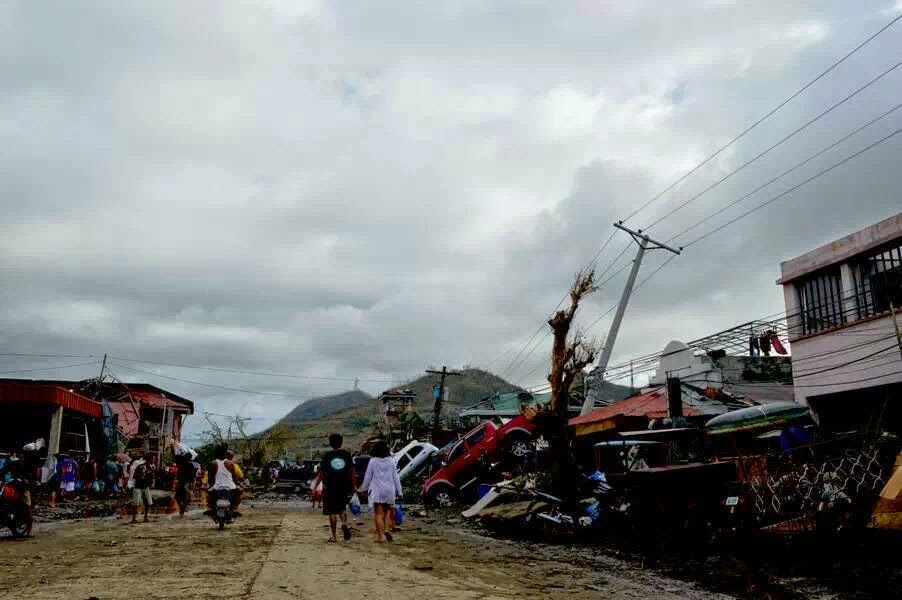
Eleven excruciating hours. That was how long residents from Leyte, Southern Leyte, Eastern and Northern Samar, and Biliran endured the howling winds and rain of Ruby.

In fairness to Typhoon Ruby, she was not as deadly as Super Typhoon Yolanda. Most Pinoys learned their lesson after last year's experience with Yolanda, which is why casualties were kept at a minimum this time around. Other than that, Ruby and Yolanda had very different "personalities." Yolanda struck fast and struck hard. In less than two days, Yolanda was out of our hair. Ruby...well, she just took her sweet time travelling along the Philippines' bosom, starting out strong but ending with barely a whisper.

Friends and former students of mine from Tacloban and Tanauan, Leyte were in constant touch with me via Facebook through the whole snail-paced movement of Ruby. It was around Saturday mid-afternoon (December 6) when the first wave of rain began to pound the area. Until evening, the wind and rain tore through the area relentlessly. Larissa, a former student of mine, related how frightened they were by the unceasing sound of roofs flapping noisily through the whole din, threatening to peel off at any given time.

The crashing, flapping, and howling in Tacloban was supposed to abate by 3 AM the next day, but Ruby had other plans. It was already 5 AM when she finally ceased. By then, almost no one there had a fitful sleep for a good 11-hour period.

Eye bags were a dime a dozen that day.


WHAT'S IN A NAME?

Some people took note of the iffy nomenclature of this most recent typhoon that wreaked havoc in most of Central Philippines. When it was still outside Philippine territory, its international name was very Filipino-sounding -- Hagupit, meaning to violently toss around or hit in Tagalog. Then when it entered PAR, it acquired a very American name -- Ruby.

What gives, you may ask?

Turns out, the term, Hagupit was among the names the Philippines submitted to this UN agency who, together with this international meteorological agency, has the privilege of endowing names on weather disturbances. The said Pinoy name was applied, together with other local names like "Maliksi," "Danas," "Lupit," and "Talas."

You may read further on this by clicking on this link.

The name Ruby, however, was concocted early on by our very own weather agency, DOST-PAGASA (Department of Science and Technology-Philippine Atmospheric, Geophysical, and Astronomical Services Administration). A bit of trivia regarding our local typhoon names: among the names of typhoons for 2014, one was eventually scratched off the list because of a person with the same name who has earned Internet fame/notoriety due to his sex videos with young ladies.

I won't share a link -- just Google the name, Kanor.


PAGASA -- ZERO TO HERO

A PAGASA weather forecaster analyzing Typhoon Ruby's
track. (Photo from GMA News)
I have to admit, I was among PAGASA's bashers when tracking of Ruby started. Other international weather forecasting agencies were up-to-date with satellite photos and maps showing the development of Hagupit and her movement toward the Philippines. Most of them would give updates almost every hour. On the other hand, PAGASA was frustratingly slow in sending out weather bulletins. Even more frustrating was the fact that they really seemed clueless at first as to the typhoon's path.

To make matters worse, PAGASA's website which was among netizens' main link to information on Ruby was already crashing due to the sheer volume of network traffic.

The poor guys were turning into laughing stocks to the point where DOST Chief Mario Montejo had to face the press and emphasize that their data on Ruby was more reliable than that of other weather agencies. He stressed that the proximity of their weather instruments to the typhoon made for better readings, thus making for more reliable data.

As Hagupit moved closer and closer to the Philippines and was renamed Ruby as soon as it entered PAR, people realized that Sec. Montejo and the rest of PAGASA's weather forecasters were right.

It no longer mattered that bulletins on Ruby had a six-hour interval. PAGASA was spot on with its forecasts.

Even CNN was already looking at PAGASA's forecasts as one of its main sources of information regarding Ruby's track.

PAGASA bashers like me ended up with the perennial egg on our faces, but I don't mind. I'm just happy that they proved me wrong.

The men and women of PAGASA who barely slept or ate during those dark days (You could actually see it on their faces during every press briefing, the poor laddies.) are among the big heroes of Ruby's onslaught.


CASUALTIES KEPT AT A MINIMUM

For such an erratic storm like Ruby, it would be impossible to hope that there would be zero casualties after it leaves.

True enough, in Ruby's wake, the death toll was, as of press time, pegged at around 20. There are government agencies who are still debating on the actual tally since some of the deaths may not have been directly caused by the typhoon.

In the Yolanda-stricken areas, there were zero, I repeat, ZERO casualties.

Having a zero, in this case, is a really good thing.

So I guess the formula for zero casualties is this:

                                     trauma from a previous catastrophic typhoon
                                     mass evacuation from coastal areas
                                     early warnings
                                     a more cooperative and more informed populace
                                  + LGU initiative____________________________
                                     ZERO CASUALTIES

International agencies are now lauding us for our disaster preparedness in the light of Typhoon Ruby. Just imagine how difficult it was for the Philippine government to move around a million individuals to higher and safer ground -- the highest-ever recorded number of people evacuated -- but they managed to do so.

This is one really strong manifestation of the Philippines learning its lessons from Super Typhoon Yolanda.


TELCOS WEATHERING THE STORM

Last year with Yolanda, among the most severe effects of the typhoon's lashing was the total shutdown of all broadcasting and communications facilities. For around 15 harrowing hours since the last news report from Tacloban City, there was a news blackout. No one outside the affected areas knew what the heck happened to their friends and loved ones. Then when news started trickling in, there was no good news -- only one bad news  after another.

Telecommunications was also on the blink, and much as we outsiders wanted to get in touch with our relatives and friends to know if they survived the storm, we could not -- and vice versa on the part of those who weathered the storm. Yolanda hit on a Friday, but I only managed to hear from my family Sunday morning. Believe me when I say that not knowing whether your family is dead or alive with no means to communicate with them is probably among the worst things one could ever feel.

This time around with Ruby, things were a little different. The telcos were readier to face the storm. I don't know exactly how they did it but a manifestation of their disaster preparedness was the fact that even while friends in Leyte were being pummeled by the storm, they were still sending blow-by-blow updates on Facebook and Twitter. (Larissa Dy, this is YOU, hehehe.)

And for this, the local telcos (Globe Smart, and Sun) deserve a pat on the back.


A STUDY IN CONTRASTS

Bunkhouses made for Yolanda survivors by the Philippine
government now destroyed by Typhoon Ruby. (Photo from 
Going back to the Yolanda-devastated areas that were once again visited by Typhoon Ruby, one scene made for a very stark study in contrasts -- the temporary shelters built for survivors whose homes were destroyed by Yolanda.

Housing units built by private/corporate entities and non-government organizations managed to withstand Ruby's wrath, with very minimal damage.

As for the supposedly international-standard bunkhouses built by the Philippine government for the Yolanda survivors, these came crashing down -- or more appropriately, were blown away -- when Ruby came a-huffing and a-puffing.

So much for this almost-a-million-pesos-worth project.

Despite the epic fail, the Philippine government still tried to defend their trashy bunkhouses, saying that these are just temporary housing units meant to withstand winds of up to 150 kph. Typhoon Ruby incidentally blew more than that so...

Still an epic fail.


IN A STATE OF SUSPENSION

Just another Erap meme.
Still learning from the lessons provided by ST Haiyan/Yolanda, another factor that led to lesser casualties (and drier people) was the timely suspension of classes and offices.

When Ruby was threatening to make itself felt in Metro Manila, many city officials were calling all major broadcasting networks as early as the afternoon before to announce the cancellation of classes in all levels in their respective areas.

All except for Manila Mayor Joseph "Erap" Estrada.

You see, many schools and universities are concentrated in the City of Manila. In fact, there are two University Belts there -- one in the Espana-Legarda-Recto area, and another in the periphery of the famed walls of Intramuros.

My daughter is among those students studying in a university located in the Recto area -- the Far Eastern University (FEU). So just imagine how anxious she was when all the other Metro Manila mayors were suspending classes while Erap was very quiet.

It was early evening already when classes in all levels in Manila were suspended. By that time, my daughter was already cussing in Waray.

I know I should've reprimanded her for the trash talk, but I guess if I was in her place, I'd be using colorful language, too. Haha.


LIGHTS ON

In fairness to the Philippine government, not all of the president's men are as (insert colorful adjective here) as the rest. I gotta hand it to Department of Energy Secretary Jericho "Icot" Petilla who promised to bring back electricity to the Leyte areas within a week after Ruby's landfall. The man did not renege on his promise.

As of this moment, people in the Tacloban-Palo-Tanauan areas are now with light, and can expect a brighter Christmas ahead.


THE WONDER DUO

I had to place this story for last as this is probably the mother of all Ruby side stories -- the epic fails of the Mar Roxas-Korina Sanchez tandem.

Korina Sanchez is a prominent anchor person usually doing the evening news at the ABS-CBN News and Public Affairs.

Mar Roxas, meanwhile, is head honcho of the Department of Interior and Local Government (DILG).

Incidentally, these two are married to each other.

I don't know what it is with strong typhoons that apparently brings out the worst in these two.

They cannot be more meant for each other, I swear.

----------

Korina Sanchez (L) and Anderson Cooper (R) (Photo from
Last year, Korina made a big ruckus during the news coverage of ST Yolanda's destruction. She never stepped foot in Tacloban City during the critical days after the typhoon struck, but CNN news anchor Anderson Cooper was on the ground seeing events unfolding with his own two eyes and making an in-depth analysis of said events.

Among Cooper's observations was the lack of national government presence in Ground Zero which was immediately bashed by Korina in her radio show. Korina noted how Cooper was a mere foreigner who should not make sweeping generalizations.

Cooper eventually found out about Korina's public berating and made his own statement to debunk whatever she said -- also before the news camera. Rest assured, that shut Korina up for sometime.

----------

Fast forward to the Ruby coverage, and Korina's golden tongue was at it again.

That time, Ruby was still outside PAR and forecasters were still confused as to where she was headed. She and fellow anchors Noli de Castro and Ted Failon were wrapping up their news for the day when they decided to discuss Typhoon Ruby's path. In a misguided show of nationalism, Korina wished that Ruby would hit Japan instead of the Philippines. De Castro tried to cover up his female co-anchor's lack of tact by saying that perhaps it would be better if half of Ruby would be felt in the Philippines, half in Japan. But Korina was adamant: "Japan na lang, kasi mas kaya nila (Just Japan because they could handle the storm better)."

And once again, Korina ate flak for breakfast.

----------

Mar Roxas, meanwhile, is just one failed publicity stunt after another. When before he gained political leverage with his campaign strategy of being a Filipino Everyman through his "Mr. Palengke" schtick, this time, mature voters have seen through the spin and are now utterly tired and disgusted by his "masa (masses)" portrayal.

His spin doctors just don't seem to get it. Mar Roxas is no "masa." He's the grandson of a former president, for crying out loud. He never was, never will be. He has never driven a pedicab in his entire life. He never directed traffic. He never hammered nails.

And he never drove through slick and muddy terrain on a motorbike.

----------

Last year, Roxas suffered from foot-in-mouth disease during his visit to Yolanda-stricken areas. It was bad enough that just before the typhoon hit, he and the rest of their government team came in unprepared. Thus, when Yolanda made landfall in Tacloban, their entire party was huddled like trapped rats in the stairwell of the Leyte Park Hotel with no means of communication. Then as soon as the skies cleared, they were eventually picked up and left the ruined city in a huff.

Roxas did return to Tacloban immediately, only to be at loggerheads with the city's mayor, Alfred Romualdez. It was in one of their meetings on disaster and relief operations where Roxas uttered the famous lines, "You are a Romualdez, and the president is an Aquino," and (while shoving a waiver surrendering Tacloban City to the national government in Romualdez's face which the latter refused to sign), "If we cannot legalize (the turnover of authority to the national government), you'll be in charge. We'll help you, pero bahala na kayo sa buhay niyo (but we leave you in charge of your own lives)."

To say that it left a bad taste in one's mouth is an understatement.

----------

This year with Ruby, Roxas was once again being his usual "epal" self. (Sorry, I don't know how to translate the word, "epal." I guess to be "epal" is to be too attention-seeking for his/her own good.)

Since Ruby made landfall a bit higher this time, hitting Eastern and Northern Samar in the process, Roxas made it a point to go there instead of Tacloban. Every now and then, his discussions with disaster personnel and local government executives from the area were aired on TV, and he did a good job just repeating what weather forecasters and the LGU reps said. Media got tired of his mimicry and eventually turned off their cameras -- until they stumbled upon this gem:

Photo from GetRealPhilippines.com

Social media was immediately in an uproar upon seeing this photo of Roxas only wearing a baseball cap and not a helmet while riding a motorbike.

You see, there is a law in the Philippines mandating the strict use of helmets when driving a motorcycle. Many motorcycle riders have been apprehended already just because they were not using a helmet.

Then Roxas is caught red-handed in this.

Of course, national government and his partymates were once again quick to defend Roxas, saying that circumstances in Samar merited the use of motorbikes, which is why Roxas was seen driving one. As for his non-helmet status, all Malacanang could say was to quit noticing Roxas' faux pas and to just concentrate on the supposed work he has done there.

What work? For the sake of a photo op?


WRAP UP

The Samarenos who may read this may disagree with me, but despite its erratic behavior, Typhoon Ruby still paled in comparison to ST Yolanda.

In fairness though, it did try to reach Yolanda's status, but failed.

Failure came not only in the sense that nature caused Ruby to weaken as soon as it hit land -- it also came in the form of Filipinos knowing better how to handle a typhoon of this magnitude.

Filipinos came in prepared to brace for Ruby's wrath. Everyone, including national government and other vital institutions, has apparently learned from mistakes committed during Yolanda's time. That is, except for the occasional epals and trapos (traditional politicians) who still have this misguided notion that typhoons are the best times for accumulating votes. (Yes, these creatures are still out there and are thriving like parasites.)

(Photo from InsuranceJournal.com)
With super typhoons becoming the new norm and the Philippines, particularly its Eastern Seaboard,
being the usual welcoming committee for these howlers, it is comforting to know that we are embracing this reality and taking the necessary steps to adjust to the change in our climate.

However, we shouldn't stop with simple adjustment. We are now very much aware of the spectre of global warming and climate change. Being one of those countries being severely affected by these new weather patterns, we also need to play an active part in the worldwide move to mitigate climate change.

There is no point denying it -- global warming is what is creating these super typhoons that will continue to slam into the Philippines, unless we do our own share.

It doesn't have to be flashy or dramatic. It doesn't even require donations.

We just have to be more respectful of our own environment. After all, this is the only planet we could live in. We destroy our planet with our negligence and abuse, we destroy ourselves.

Sir David Attenborough couldn't have said it any better: "There is no question that climate change is happening; the arguable point is what part humans are playing in it."

(#)

Wednesday, November 19, 2014

Countdown to Yolanda: The Mission

(Continuation from Countdown to Yolanda: Knowing)

One tote bag -- that was all I brought with me to this rescue mission to get my family out of the ruins of Tacloban City.

I remember having only one change of clothes. Didn't even bother to bring clothes for an overnight stay.

Even my footwear was not flashy. Whatever slippers I had on in my Sta. Mesa, Manila residence was the same pair I used all throughout this endeavor. 

I had to make sure that I would blend with the background -- as if I was a typhoon survivor myself.

----------

Gonz, his son, Iggy, and I met in the airport early the next day (November 12). Gonz was obviously not feeling well, and asked for my apology that he couldn't come along. Instead, Iggy was to come with me in his place. 

And the kid was armed to the teeth with this massive knapsack and accompanying water canteen.

Okaaaayyy...I now have a teenager with this giant of a bag coming with me on this trip. I could only imagine what will go through the minds of potential thieves when they see Iggy's bag -- "Jackpot!"

I asked Iggy if he was already briefed by his dad on what he was to see when we got to Tacloban. The kid vigorously nodded with enthusiasm. "This is going to be one big adventure!" he declared.

Adventure, huh, I thought to myself. Let's see how enthusiastic you will still be when you start seeing dead people. And when thieves run away with your knapsack.

----------

It was disconcerting that commercial flights to Tacloban were opened only that day but were already filled with passengers. There were also no flights going straight to Tacloban; the best route was via Cebu, and the schedules were difficult to fix given our limited time. Thus, we settled for two Business Class tickets to Cebu (Yup, those were the only ones available that time; thank God for money trickling in from concerned high school batchmates). Then we had to stay overnight in Cebu before riding the plane to Tacloban. We also got tickets for our return trip (still via Cebu), complete with tickets for my mom and daughter. The return trip also entailed for us to stay overnight in Cebu so my family can rest first after the harrowing events of days before.

A little later that day, Iggy and I were already on the plane to Cebu.

----------

Iggy and I stocked up on supplies for the Tacloban trip in SM Cebu, and since it was Iggy's first time to get to Cebu as a grownup, I gave in to his request for us to have a short tour of the city. We got ourselves billeted into a nice inn near the airport, then early the next day we were on the plane to Tacloban City -- or what was left of it.

----------
In what was left of the Daniel Z. Romualdez Airport (From 
personal photo archive)

The plane hasn't alighted yet but from the air, I could clearly see the damage brought about by ST Yolanda's fury on the Tacloban coastline. When airplane wheels made contact with the ground, the damage was even more telling. Fronds on coconut trees were frozen pointing toward one direction. Vegetation was flattened as if a giant sat on it.

Then the Daniel Z. Romualdez Airport came into sight.

I left this airport a week ago looking quite portly. I returned after more than a week and the building was transformed into a gnarled mess of sheets, metal, and concrete slabs.

And the waterworks began.

----------

It was bad enough that the airport looked like some unseen hand pounded on it relentlessly. 

The people milling around it looked just as devastated. They had that blank, dark look in their eyes, and they did not seem as if they actually were going in one direction at all.

If there was a sight to describe the word, "chaos," then that scene at the airport was it.

The only ones at the airport with an apparent purpose in their gestures were the foreign media stationed there. I approached one of them hunched over some communication equipment in the hope that he could point me toward the station of the local Reuters crew who, according to their Philippine bureau chief who was a friend of mine, had a vehicle. When he stood up to reply, I saw the embroidered patch on his vest. It said, BBC. The hulking man answered in beautiful-sounding British English that he wasn't sure where the local crew went as most of the media with vehicles were busy scouring the countryside for news. Heck, I was no longer listening to his answer -- I was too awestruck listening to his British accent.

----------
Signs of the times on the long road to Housing. (From 
personal photo archive)

Seeing that looking for the Reuters team was futile, Iggy and I decided to just start our trek to the Housing area on foot. However, by some stroke of luck, our trip to Housing was made easier after we managed to hitch a ride on a Tamaraw vehicle owned by a Baptist church in the Fatima Village area. The driver wanted to drive us straight to Housing, but he had an extended family of survivors from hard-hit San Jose to transport elsewhere. Thus, we got down in the Rotonda area near the Coca Cola Bottling Plant in Sagkahan which was roughly half of the whole journey to our destination.

A woman with two kids were with us on that ride, and they were also going the same way we were going. I thought to myself that if we kept this woman and her kids with us long enough, there may just be a chance that the driver of a passing vehicle/motorcycle/pedicab may take pity on all of us and give us a ride. After around a kilometer or two of walking and hailing vehicles, we got successful and managed to get a ride on a motorcycle-cab all the way to Housing -- for the steep price of P500. We went down and let the woman and her kids go on for the rest of the motorcab ride, and I braced myself for the worst.

----------


The tall house with orange and white paint in the background
was where my family took refuge at the height of the storm. 
Note the lack of eaves under its roof. That was where everyone
in that house climbed to avoid the rising floodwater. (From 
personal photo archive)
Before going to where my family evacuated in nearby Housing Mountainside, I told Iggy to come with me first to see what was left of our rented bungalow in Housing Seaside.

It just tore my heart to see familiar surroundings ripped apart just like that.

I walked through our street, tears running down my cheeks unabated, as I saw houses torn from their foundations, cars piled on top of the other, fallen trees obstructing the road, and other scenes of destruction. The stench of death was not as bad here as when our Tamaraw vehicle passed by the San Jose area earlier, so I was hoping that there were not as many deaths that occurred in the neighborhood.

When I got to the vicinity of our house, I immediately saw our neighbors who shared their house with my family during the time Yolanda struck. I ran to them, hugged them, and gave them a teary greeting and expression of thanks for saving my family from the storm surge. As usual, they were forever the gracious neighbors who told me not to thank them but to thank the One Up There instead.

----------

Mano Ely, one of our wonderful neighbors, offered to bring Iggy and me around the subdivision before accompanying us to where my family was situated in the other subdivision. He related to us how the waters reached up to the second floor of their house, and how they were forced to destroy the ceiling so that they could avoid the fast-rising floodwater. He also named other neighbors whose lives were snuffed out by Yolanda. Residents of the white house on the other corner of our very own block were trapped inside and eventually drowned when the waters engulfed their home. The wife of another neighbor was just too weak to climb to the roof and eventually submitted herself to the raging waters. Another family in our neighborhood who, like my family, consisted of three generations of females (grandmother, mom, and a two-year old daughter), also succumbed to the flood. All of them lived in bungalows just like our residence. If my family did not heed my instruction to evacuate to Mano Ely's relatives' place with a second floor, Lord knows what kind of fate could have befallen them.


What remained of the bungalow my family lived in for many 
years. (From personal photo archive)
Of course, I had to see what was left of our place, hoping against hope that I may just be able to salvage some belongings before Iggy and I continued to my family's location.

The gate, notwithstanding how flimsy, was still standing, although bent.

But the house...I could hardly believe that my family used to live there.

There was just so much debris in the yard.

The electric post situated in front of the house was now on top of it.

A coconut tree decided to join the fray and also landed right smack on the house.

Much as I wanted to attempt going in, Mano Ely advised me against it because the weight on top was very unstable and could cave in at any moment. Plus, there was also the  risk of snakes finding refuge inside the house.

I could only stand there and say goodbye to a lifetime's worth of possessions and memories gone to waste after only three to five hours' battering by Yolanda.

After saying a little prayer for those among our neighbors who fell victim to the scourge of Yolanda, Iggy, Mano Ely, and I set on for the short trip to the next subdivision to reunite with my family.


(To be continued)

Tuesday, November 11, 2014

Countdown to Yolanda: Not Knowing

(Continuation from Countdown to Yolanda: Day Zero)

It was not a good feeling to walk around with a ton of heaviness in one's heart, especially when the reason for the heaviness is the hunger for information -- any information -- on the whereabouts and status of one's family.

For that moment, I could suddenly relate to the pain and anguish of families of kidnap victims and missing children.

Messages of concern started pouring in my Facebook wall, all wishing that I find my family soon. At the same time, more footage and news from Leyte were also coming in, one even more depressing than the first.

By this time, I had a better idea of the extent of Yolanda's fury.

CNN and other international news agencies were correct in saying that Yolanda was so far, the strongest typhoon to ever hit land in the whole of written history. It hit Guiuan, Eastern Samar and Tacloban City with the force of several atomic bombs going off at the same time.

The winds and rain of Yolanda were unprecedented but somehow, expected.

 However, Yolanda had a more deadly surprise that caught everyone flat-footed.

This was the very first time that I have come across the phenomenon called a storm surge.

Unfortunately, so did the people of the Visayas region.

And thus, news about certain barangays being "washed out" became the news of the day as of November 9.

I found out about a second cousin whose seaside home was literally eaten up by the storm surge -- with my second cousin in it.

The parents and youngest brother of an old flame of mine, also from Tanauan, also died in the storm surge. Apparently, they got trapped in their rooms when the stream located behind their house overflowed and the waters rose rapidly. Their house was a bungalow. It also disappeared in the storm surge. Had he not been able to leave for the States just a few months back, he could've become one of their family's casualties.

A nephew of mine left home the day before the storm hit. As of that time, he went missing.

And until afternoon, I still didn't have any idea what happened in Housing Seaside, especially to my family.

I entered my mom's and daughter's names in this Google document of missing persons. Also asked for help from a high school batchmate of mine who was immediately flown to Tacloban City for emergency disaster work. None of them yielded positive results


My high school batchmate added that Housing Seaside was thoroughly washed out and he didn't want to raise my hopes about finding my family.

And then, I found this posted photo of the corner going to Housing Seaside.

Blimey, the area looked like a scene from this popular zombie series -- only without the zombies.

If this was how  the corner looked, what more for the actual subdivision?

This was when I started to contemplate on a future of being a neurotic and crazy cat lady.

----------


I was not the only one going bonkers from worry over relatives in Leyte. I was also in touch with former students of mine from UP Tacloban who, just like me, are already working/living outside Leyte. The shared frustration somehow brought all of us together to console each other and to provide shoulders to cry on.

Believe me when I say that there were a lot of wet shoulders that time when all of us Manila-based UP alumni met for the first time on the afternoon of November 9.

The kids took one step further and decided to create a group with its own Facebook page, initially, with the intent to share any and all information on developments in Region 8. Later on, it turned into a bustling socio-civic entity made up of alumni, students, and former faculty of UP Tacloban. And thus, Bulig Isko was born. "Bulig" is the Waray term for help, while Isko is short for "Iskolar ng Bayan (scholars of the state)," a moniker for students from the University of the Philippines.

----------

That afternoon, the kids set up a mini communications center in one of those coffee places in the Mall of Asia (MOA) area. Even if we were staying there for an extended period of time, none of the crew dared to shoo us away as they seemed to understand why we were there. I wanted to help the kids with the organizing stuff, but my mind just wasn't there -- it was far away, back in the muddied roads and destroyed houses of Housing Seaside. Every now and then, a kid would jump and cry in jubilation after finding out that his/her family is alive. However, with every kid finding his/her family, I only got more depressed.

After around three hours of waiting for nothing, I decided to leave the kids to their plans and go home. 

As I lay in bed that night, I imagined living the rest of my life without a family to return to. No one to work my butt off for, no one for me to get angry with from leaving stuff strewn all over the house, no one to buy medicines for...

At least, I had my cats.

But that wasn't too reassuring.

Then I closed my eyes and said a prayer, asking for good news the next day.

(To be continued)


Photo credits: First photo is from Google Images; second photo is from the Bulig Isko Facebook page.

Friday, November 7, 2014

Countdown to Yolanda: Day Zero

(Continuation from Countdown to Yolanda: The Paranoia Buildup)

Sleeping was no longer an option for me in the wee hours of November 8. I was frantically going through Facebook and several other sites on my tablet (I didn't own a TV set then) that gave me information about the super typhoon, as well as advice on what to do in the event of disasters. I was also coordinating with my family in Tacloban, making sure that they were physically and mentally ready for the coming deluge.

It was around 3:30 AM when I managed to call my daughter for the last time before the typhoon hit. Ingrid (my daughter) noted that Yolanda was around two hours away from landfall but they were just having rains common for a Signal No. 2 typhoon only. She also complained about her Lola (grandmom) spending too much time arranging stuff at home when she should've taken a rest before the storm made landfall.

Ingrid's report about the manageable weather made me a little less paranoid and a bit hopeful that this Yolanda won't be as catastrophic as media and weather forecasts claim it to be. For a brief moment, I became calm enough to fall asleep.

I was sooo wrong.

I was awakened by my cats at around 6 AM. The first thing I did was to check my mobile phone to see if Ingrid tried to get in touch with me while I was in deep slumber. Turns out, she did -- at around 5 AM when Yolanda was to make landfall.

A surge of panic overwhelmed my being. My daughter is not one to text me, much less, call me up, even in dire situations. However, plastered over my phone's face was the notification that she CALLED me up at 5 AM.

I tried to call Ingrid up but to no avail.

I turned to my tablet and opened the local TV app I managed to download just before the storm. It was already tuned in to ABS-CBN and the first thing I saw on my screen was reporter, Atom Araullo, reporting in full battle gear, with ferocious winds and rain hitting him from all directions.

And his background was the angry bay -- the same bay I would pass by whenever I went home to Housing Seaside.

I could only cover my gaping mouth in disbelief.

Once again, I tried to get in touch with Ingrid. Still nothing. Now, I regretted the fact that I fell asleep when I should've stayed up so I could've taken my daughter's call.

My mouth went dry when the thought of our house being pummeled by those angry winds and rain came into mind.

It won't stand a chance.

----------

The last footage I saw before all on-the-spot reports about Yolanda blacked out was of Atom reporting from inside a building, the glass windows of which were already shattered. All the while that he was reporting, the camera was directed toward the building across which was rapidly being inundated by flood water. In a matter of around 10 minutes, the water was already lapping at the building's eaves.

Then, just like that, Atom's signal went down.

----------

It is a terrible feeling to be blind to what was happening to my family while Yolanda was busy wrecking havoc over the city. Did they manage to evacuate to the neighbor's two-storey house in time? Will their "evacuation center" withstand the storm's fury? What will become of the bungalow my family has lived in for several years already? Just how far is Housing Seaside from the actual seashore?

Will they survive this freakishly strong typhoon?

What would happen to me if they didn't?

I tried to erase that last thought as I went on with the rest of the day barely eating or resting.

I turned to Facebook to air my feelings that time. As it turned out, there were a number of my former students who were also online and whose nerves were just as frayed as mine. Just like me, they were living away from their respective families residing in Leyte. We went to each other for comfort and news as there really wasn't anything else we could do.

Then by around 10 PM that night, the first fresh news straight from Leyte came in via Jiggy Manicad and Love Anover of GMA News.

According to Jiggy, when communications systems in Tacloban were felled by Yolanda's wrath, his team walked for hours to Palo which is a good 15 kilometers away to report from their satellite station there and to reunite with fellow reporter and Alangalang, Leyte native, Love.


While Jiggy and company experienced the difficulty of distance walking over debris and corpses, Love had a more blood-curdling story with complementing footage to boot. She and her team sought shelter from the storm at the massive Palo Cathedral, confident with the thought that this is a protected haven of God. However, she soon realized that this structure was simply no match for the forces of nature.

My heart felt like it was being torn to pieces as I watched the footage of the Palo Cathedral being blown to smithereens.

At the very same time that I was watching that GMA News footage, outside my place, winds from Yolanda's fringes were picking up.

Then I wondered. I was very sure that if the Palo Cathedral was a tangled mess of steel and concrete after Yolanda was done with it, what more for our run-down bungalow in Housing Seaside? If my family did survive Yolanda's onslaught, where would they be sleeping tonight?

And I finally broke down in tears.

(To be continued)

- Photo credits: Atom Araullo's photo from Google Images; GMA News footage from YouTube

Thursday, November 6, 2014

Countdown to Yolanda: An Anxious Eve

(Continuation from Countdown to Yolanda: The Paranoia Buildup)

Concentrating on other things apart from the coming storm was already impossible for me by November 7 -- the eve of Yolanda. Since I knew I was just going to be useless if I went to the office, I decided to stay home and keep posted on developing events.

By this time, Yolanda was virtually roaring over the edges of the Philippine Area of Responsibility (PAR). She has already escalated to a Category 5 cyclone, and CNN was going over the top with its fearful forecasts for when the super typhoon makes landfall in Tacloban City and Guiuan, Eastern Samar. Words like "catastrophic," "apocalyptic," and "massive" were constantly used in relation to the coming super typhoon, and this only added to my anxiousness.

There was a brief respite that day from all things Yolanda-related -- the first appearance of pork barrel scandal queen, Janet Napoles, in the Senate hearing related to alleged misuse of the pork barrel fund. By the end of that well-publicized hearing, people were quoting Napoles' overused lines, "Di ko po alam (I don't know)" and "I invoke my right from self-incrimination."

However, just moments exactly after the Senate hearing ended, then came the announcement from PAGASA, the Philippine weather bureau, that Yolanda has been upgraded to Signal No. 4.

And this massive weather disturbance was barreling toward Eastern Visayas at more than 200 kph per hour, Estimated time of Yolanda's landfall, early morning of the next day.


Funny though -- in Tacloban, my family was looking at the sky and noted that apart from the occasional clouds, the weather looked far from a Signal Number 4 upgrade.

Nevertheless, I told my family not to underestimate the storm's strength. The storm upgrade was supposedly meant to be an early warning for residents of affected areas to take the necessary precautions.

Speaking of precautions, I gave my daughter an extra instruction that she only understood after the storm hit.

I requested her to take pictures of our rented bungalow before and after the typhoon.

She was too confused to take the before pictures. She never got to take the after pictures.

(To be continued)

Video from Youtube

Tuesday, November 4, 2014

Countdown to Yolanda: The Paranoia Buildup

(Continuation from Countdown to Yolanda: The Week Before)

It was probably around November 4 or 5 when I first heard about this storm brewing over the Pacific in the vicinity of Guam. It didn't even have a name yet, only that initial forecasts say that it was headed for the Philippines.

By November 6, this weather disturbance was a full-blown howler with the international code name, Haiyan. Even while at sea, it was already churning with the ferocity of a Category 4 cyclone, and it was still increasing in strength and area. By this time, Haiyan has already captured the attention of weather forecasters, scientists, and storm chasers the world over, and all of these experts have pinpointed the potential path the super typhoon would take.

All eyes, fingers, and map markers were pointing at the central portion of the Philippines as the most likely area where this storm will make landfall.

Oh great, I said to myself. I just ironed out some problems in Tacloban City only several days ago. Now here's another problem to ponder on.


I remember staring at the screen of my office PC -- just staring, not really reading what was on the screen on the afternoon of November 6. I could barely let go of my tablet as I was tuning in to any news about the coming typhoon.

Soon, satellite images were cropping up on my tablet's screen.

Wow.

This beastie of a typhoon looked like it could take down an entire country in one gulp. It was just one angry, swirling mass of ugliness headed right toward the general direction of Leyte.

Then the international news agencies were beginning to crow about this howler being so far, "the strongest tropical cyclone ever, even stronger than Hurricanes Katrina and Sandy."

Now, I was terrified.

By evening when I got home, I immediately called on my family to find out if they knew exactly what they were in for. They knew.

But they weren't sure of the extent of destruction this typhoon could wreak on them.

Being the stronger one between my two girls, I concentrated on instructing my daughter what to do in preparation for the super typhoon they now called Yolanda. I told her to ready two emergency bags -- one for her, another for her Lola (grandmother), and I also texted her a list of what to place inside each bag.

I also instructed my daughter to talk to our friendly next-door neighbors (the ones who invited us to a birthday party several days before) and request if my family could evacuate to their house which is sturdier than our rented place. Their house also has a second floor, as compared to our rundown bungalow, and has a better chance of keeping everyone high and dry in the event that floods would inundate the area.

Floods.

That time, all I was worried about was how our little bungalow would be able to withstand the ferocity of Yolanda's winds, The floods would be inevitable in Housing Seaside, especially since the area is quite flood-prone, but that would be the least of my problems. Or so I thought.

My mom even reassured me that since repairs and some cleaning were made on the canal just behind our place, flood water will just run unhampered into the canal without rising to uncomfortable levels.

Not one among us knew that something even worse than flood would strike our area just as fast as a boxer's uppercut.


(To be continued)

Photo credit: Google Images